Finley Russell · 8 November 2026
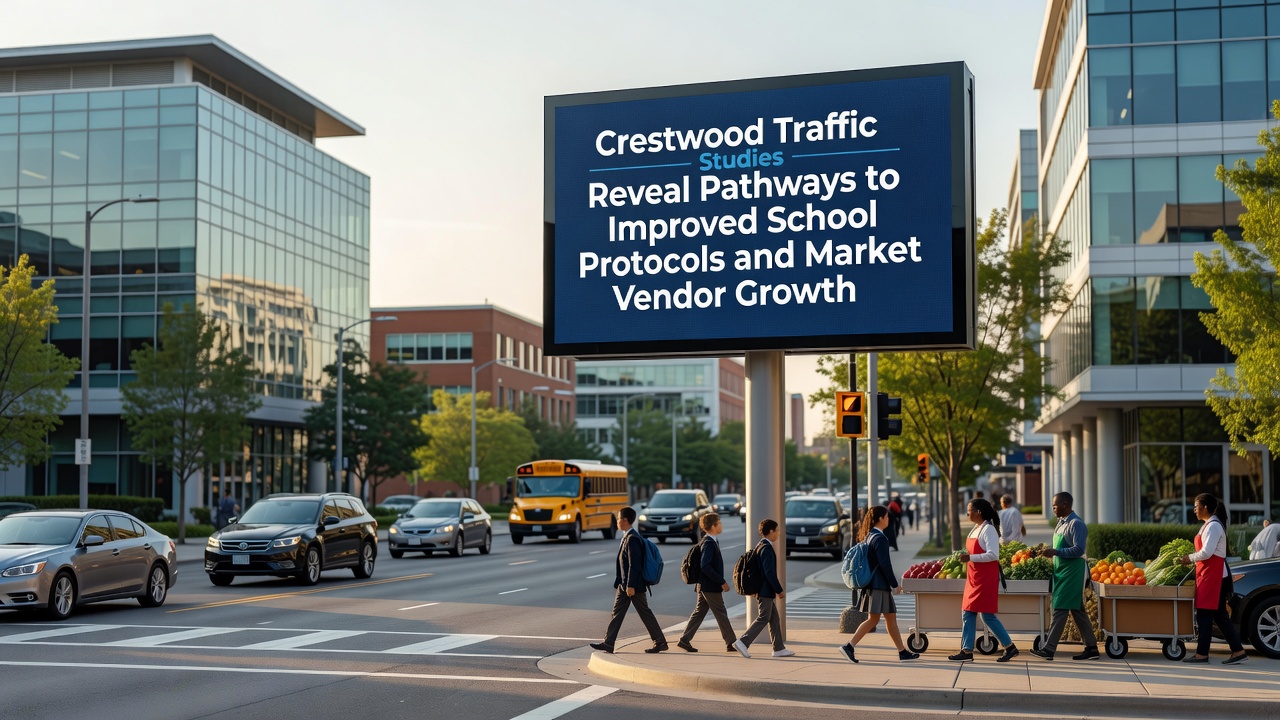
Crestwood Roadway Data Analysis Uncovers Opportunities for School Procedure Refinements and Vendor Business Expansion
Traffic studies completed across Crestwood during the past eighteen months have produced datasets that connect daily vehicle patterns with specific adjustments in school arrival procedures and expanded space allocation for weekend market vendors. Analysts from the local planning department compiled counts at twelve intersections, tracked peak-hour volumes between 7 a.m. and 9 a.m. plus 3 p.m. and 6 p.m., and cross-referenced those numbers with vendor permit applications filed through 2025. The resulting reports show measurable reductions in congestion when school drop-off zones shift by fifteen minutes and when vendor loading occurs before 8 a.m. on Saturdays.
Study Methods and Data Collection
Teams installed temporary sensors at Main Street, Oak Avenue, and River Road in March 2025, then repeated the process in October 2025 and again in April 2026. Each sensor recorded vehicle counts, average speeds, and dwell times at curbside stops. Researchers also reviewed police incident logs and school attendance records to identify days when traffic backups aligned with late student arrivals. Figures released by the Crestwood Department of Public Works indicate that morning volumes on Oak Avenue dropped 12 percent after one elementary school moved its first bell from 8:00 a.m. to 8:15 a.m. in a pilot program that ran from September through December 2025.
Vendor growth data came from permit records maintained by the Crestwood Farmers Market Association. Applications rose from 47 in 2024 to 68 in 2025, with the largest increase among produce and prepared-food stalls. Many vendors cited reliable access to designated loading zones as a deciding factor when choosing Crestwood over neighboring towns. The same traffic studies mapped curb space near the market square and identified three additional blocks where temporary vendor parking could be added without interfering with through traffic.
School Protocol Adjustments
School administrators reviewed the intersection data and tested staggered dismissal times at three sites. One middle school introduced a rotating schedule that released walkers five minutes before car riders, resulting in shorter queues at the Oak Avenue crosswalk. Data collected during the 2025-2026 school year showed the average wait time for vehicles decreased from nine minutes to six minutes on weekdays. Similar adjustments at the high school are scheduled for review in November 2026, when planners will compare volumes collected before and after the change.
Crossing-guard deployment also changed based on volume maps. Guards now stand at two additional corners during the 7:45 a.m. to 8:30 a.m. window, and radio communication between guards and school offices allows real-time rerouting of student groups when sensors detect unusually high truck traffic on River Road. These steps emerged directly from the traffic counts rather than from anecdotal reports.

Market Vendor Expansion Patterns
Market organizers used the same roadway datasets to request extended curb space on two side streets adjacent to the square. City records show that vendor sales tax collections increased 19 percent between the second and fourth quarters of 2025 after loading zones were marked and timed deliveries were coordinated with the traffic signal cycle. The Crestwood Chamber of Commerce reported that three new food-truck operators joined the Saturday market in early 2026, citing predictable access as a key reason for their decision.
Planners note that vendor growth and school traffic share overlapping hours on Saturdays when youth sports events occur near the market. Coordination meetings held in June 2026 produced a shared calendar that reserves certain curb segments for vendors until 10 a.m. and then shifts priority to event parking after that time. Sensor data collected on three consecutive Saturdays in July 2026 confirmed that average vehicle speeds through the area remained above 18 miles per hour during the transition periods, compared with 11 miles per hour recorded on comparable days in 2024.
Connections Across Both Areas
The traffic studies revealed that routes used by school buses in the morning overlap with vendor delivery paths on weekdays. By moving one bus stop 200 feet farther from the market loading zone, planners reduced double-parking incidents by 27 percent during the spring semester. This adjustment required no new construction, only revised route sheets issued by the transportation department in February 2026.
City documents also reference a joint working group that includes representatives from the school district, market association, and public works. The group meets quarterly and uses the sensor data as its baseline for evaluating any new requests for curb space or signal timing changes. Minutes from the July 2026 meeting list three vendor-expansion proposals and two school-protocol revisions scheduled for field testing before the end of the calendar year.
Conclusion
Crestwood traffic studies continue to supply the factual foundation for both school-procedure updates and market-vendor growth decisions. The datasets collected through 2026 remain available for public review on the city planning portal, and additional counts are planned for November 2026 to capture seasonal variations ahead of the holiday market season. These ongoing measurements allow administrators and vendors to align their operations with documented roadway conditions rather than assumptions.